Design for manufacture, explained
Design for manufacture is the difference between a product that works and a product that can be built cheaply, again and again, without drama. It is also where most of a product's cost is quietly decided, long before anyone orders a single part. Here is what it is, why it pays to think about it early, and the principles that do the work.
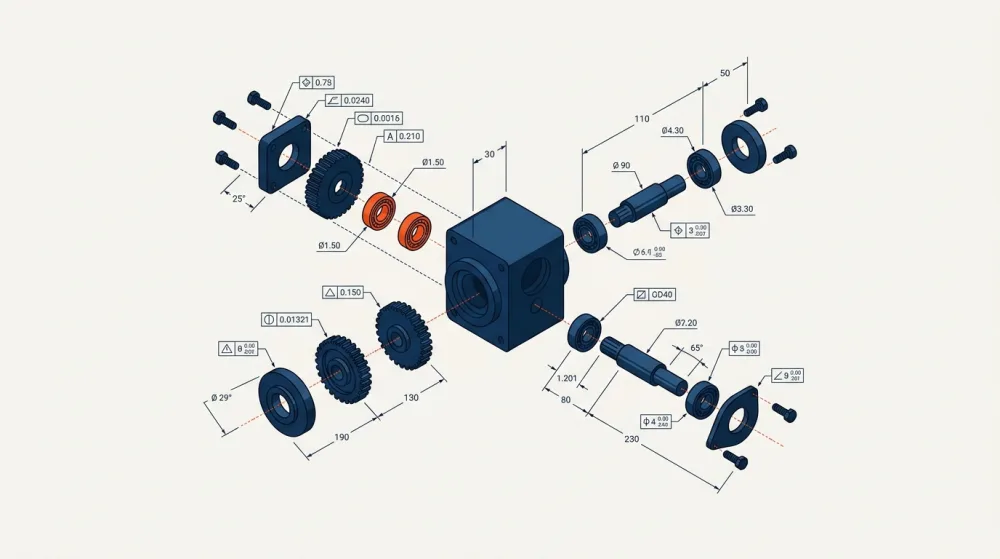
The gunsmith who took a musket lock from a heap
In 1785 the American minister to France, Thomas Jefferson, watched a Parisian gunsmith named Honoré Blanc do something that ought to have been dull and was in fact revolutionary. Blanc had made the parts of his musket locks so uniform that, as Jefferson wrote home to John Jay, they could be "taken promiscuously from a heap" and assembled into a working lock at random. No filing, no fitting, no skilled hand coaxing this piece to marry that one. Any part fitted any assembly.
It sounds like a parlour trick. It was, in fact, the beginning of mass production — the principle that would later be called the American system of manufactures and would build everything from Springfield rifles to the Model T. And the insight underneath it is precisely design for manufacture: Blanc did not make his parts interchangeable by working harder at assembly. He made them interchangeable by designing them to a controlled tolerance, so the difficulty was solved on the drawing board rather than at the bench. That is the whole idea, and it is more than two centuries old. A prototype needs a clever hand. A product needs to work without one.
What design for manufacture is
Design for manufacture — often shortened to the letters D, F and M — is the practice of designing a product so that it is easy and cheap to make repeatably, not merely so that it functions. A prototype only has to work once, on a bench, built by the person who designed it. A product has to be built by someone else, to the same standard, thousands of times, on a line. Those are different problems, and design for manufacture is how you solve the second one on purpose rather than by accident — the difference between Blanc's heap and a skilled fitter working late.
In practice it means shaping every part to suit the process that will make it, choosing components a factory can actually buy and handle, and specifying precision only where the function needs it. It is not a phase that happens after design. It is a way of designing.
Why it matters early
A product's cost is largely locked in by its design, and most of that is settled in the earliest decisions — the part choices, the materials, the way things fit together. Those decisions are nearly free to change on a drawing. They become expensive once tooling is cut, and painful once production has started and every change ripples through work instructions, inventory and validation.
So the value of design for manufacture is highest at the start and decays as the design freezes. Applied early, it costs an hour of thought; applied late, it costs a redesign, or a higher unit price you pay on every unit for the life of the product. This is the whole argument for bringing a manufacturing view in while the design can still move — and the reason Blanc worked on the tolerance, not the assembly line.
The principles that do the work
Design for manufacture is not a mystery. A handful of principles deliver most of the benefit, and they reinforce each other:
Reduce the part count
Every part is bought, stocked, inspected, handled and assembled. Fewer parts means fewer of each of those costs and fewer things to go wrong. Combining two parts into one moulding, or designing a part out entirely, is often the single biggest saving available.
Use standard parts
A standard fastener, connector or bearing is cheaper, available from several suppliers, and carries no tooling cost. A custom part means a mould or a machining setup and a single source. Reach for the catalogue before the custom drawing.
Loosen tolerances where you can
Tight tolerances cost money — in tooling, in slower machining, in inspection and in scrap. Specify precision only where the function truly needs it, and let everything else run to a comfortable, cheaper band.
Match the process to the volume
3D printing and machining suit low volumes; injection moulding and casting suit high ones because tooling amortises. Choosing the process before the geometry is fixed lets you design a part the chosen process makes cheaply.
Design for easy assembly
Parts that only fit one way, self-locate, and stack in one direction cut assembly time and error. Design out the awkward reach, the blind fastener and the part that goes in upside down.
How it saves cost
The savings are not one dramatic cut; they are many small ones that apply to every unit forever:
Because each saving repeats on every unit, a few pounds shaved per unit becomes a serious number at volume — and it lands straight in your gross margin. This is why interchangeable parts did not merely make muskets tidier; they made an industry. Seeing where those pounds sit is easier with a costed model in front of you: a Fractional Forge Design Dossier lays out the bill of materials and the landed unit cost so you can spot the part-count, tolerance and process savings worth chasing. Your first one is free — though the principles above will improve almost any design on their own.
Common questions
What is design for manufacture?
Design for manufacture (DFM) is the practice of designing a product so that it is straightforward and cheap to make repeatably, not just so that it works. It means shaping parts to suit the chosen production process, reducing the number of parts, favouring standard components, and specifying only the precision the function needs. The aim is a design that is as easy to build reliably as it is to build once.
Why does design for manufacture matter early?
Because the cost of a product is largely locked in by its design, and most of that is decided in the first design decisions. Changing a part choice on a drawing is free; changing it after tooling is cut is expensive; changing it after production has started is painful. Applying design for manufacture while the design can still move captures the saving cheaply — leaving it until later means either paying to redesign or accepting a higher unit cost for the life of the product.
What are the key principles of design for manufacture?
Reduce the part count, favour standard off-the-shelf parts over custom ones, loosen tolerances everywhere the function does not need precision, choose a production process that suits your volume and then design the part to suit it, and make the product easy and unambiguous to assemble. Each principle removes cost, risk or both, and together they compound.
How does design for manufacture save money?
It attacks cost on every front at once: fewer parts to buy and handle, standard parts with no tooling and multiple suppliers, looser tolerances that cut machining time and scrap, a process matched to the volume so tooling is not wasted, and faster assembly with fewer errors. Because these savings apply to every unit for the life of the product, a modest improvement per unit becomes a large number at volume.
Want to see where the cost sits?
Describe your product in a short brief and get a Design Dossier — an auditable, engineer-checked model with the bill of materials and landed unit cost, so the design-for-manufacture savings are easy to find. Your first one is free.
Start a brief